 kanji60s
Grammar
The Japanese て-Form: Easy Conjugation Rules and 6 Key Uses
The て-form is the most useful verb form in beginner Japanese. You need it to ask for things, say what you are doing right now, link actions together and ask for permission. Once you know the pattern, every verb follows it.
- The te-form links actions and builds many key patterns.
- Group 2 verbs drop る and add て: 食べる → 食べて.
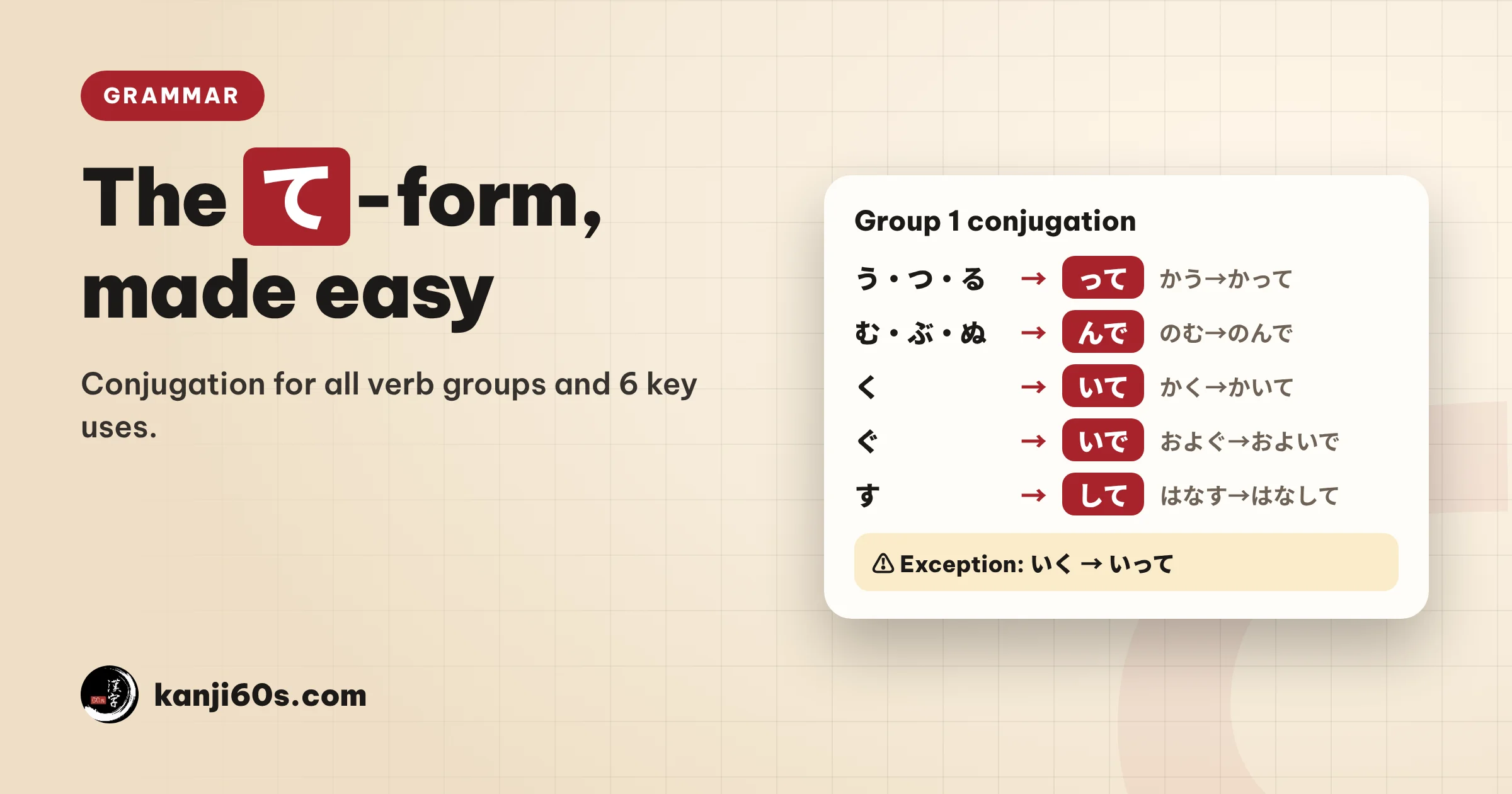
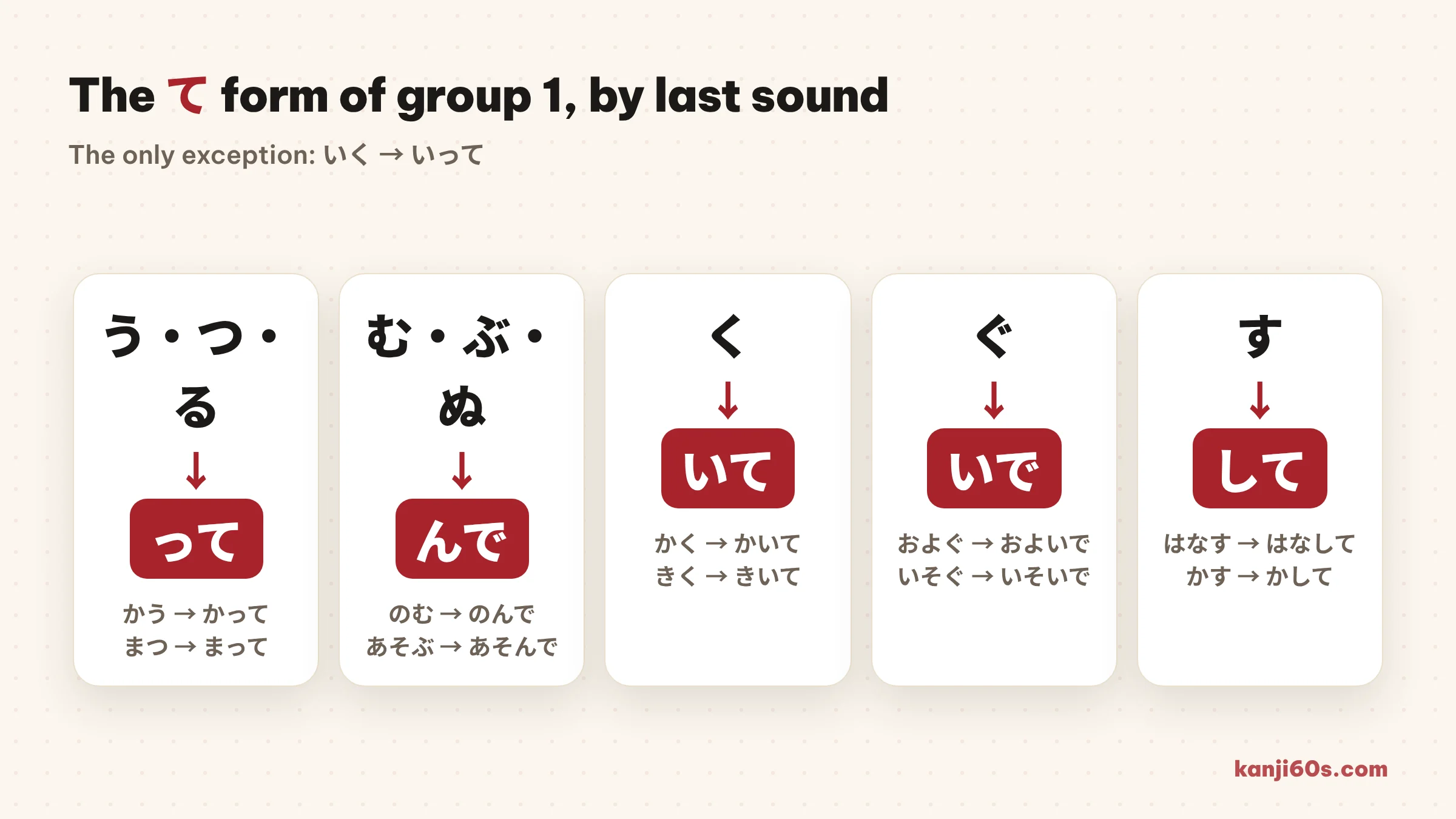
- Group 1 verbs change by their last sound: う・つ・る → って, む・ぶ・ぬ → んで, く → いて, ぐ → いで, す → して.
- Exception: 行く → 行って. Irregular: する → して, 来る → 来て.
Step 1: know the verb group
- Group 1 (u-verbs): 書く, 飲む, 話す, 待つ…
- Group 2 (ru-verbs): 食べる, 見る, 起きる… (drop る)
- Group 3 (irregular): する → して, 来る → きて
Step 2: the sound chart for group 1
| Dictionary ending | て-form | Example |
|---|---|---|
| う・つ・る | って | 買う→買って、待つ→待って、帰る→帰って |
| む・ぶ・ぬ | んで | 飲む→飲んで、遊ぶ→遊んで、死ぬ→死んで |
| く | いて | 書く→書いて(exception: 行く→行って) |
| ぐ | いで | 泳ぐ→泳いで |
| す | して | 話す→話して |
Group 2 is easy: replace る with て (食べる → 食べて, 見る → 見て).
Step 3: six uses you need
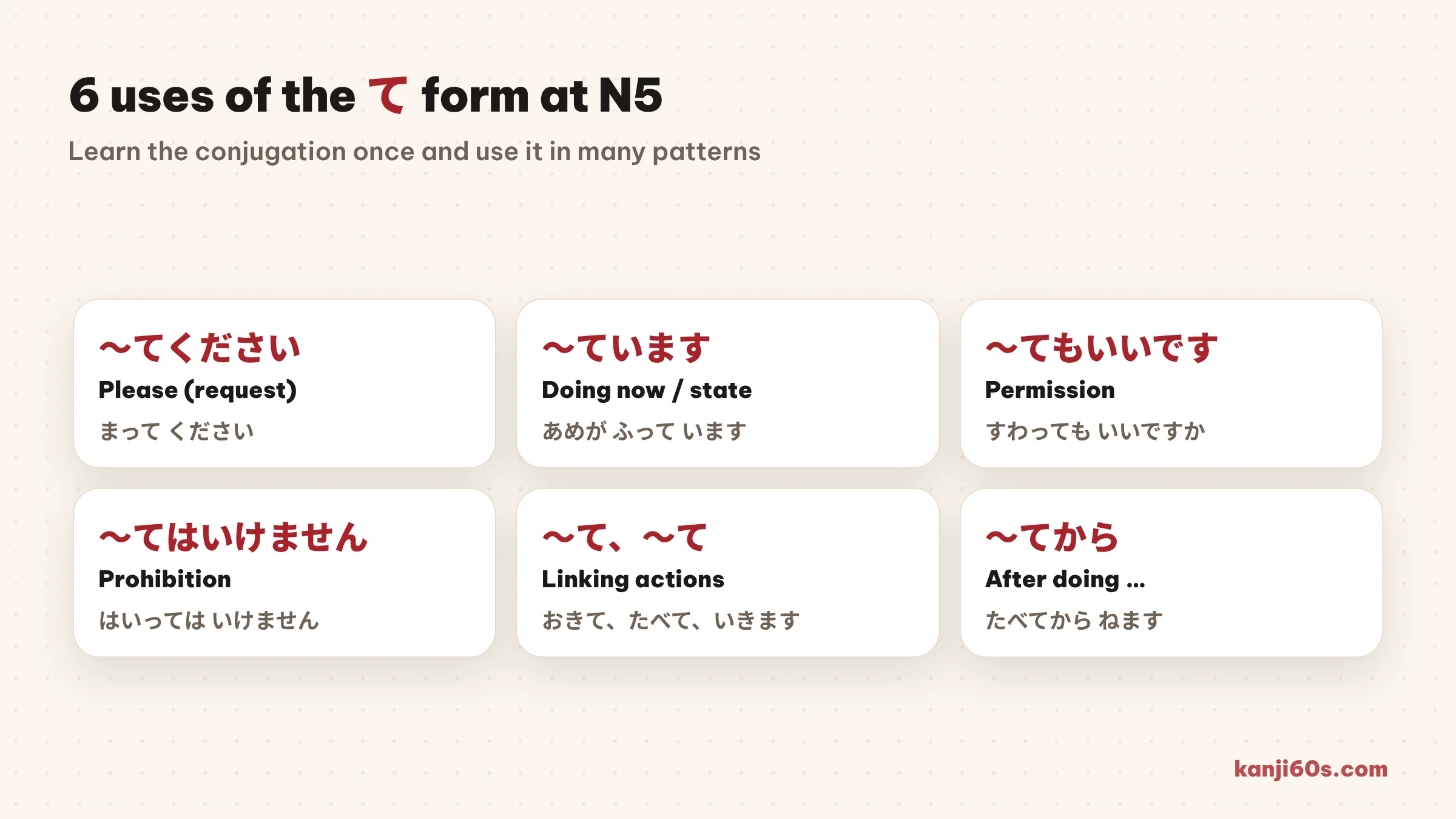
- Requests — Vてください: ここに名前を書いてください。 Please write your name here.
- Ongoing action — Vています: 今、ご飯を食べています。 I am eating now.
- States — Vています: 東京に住んでいます。 I live in Tokyo.
- Sequence — Vて、Vて…: 朝起きて、顔を洗って、学校へ行きます。 I get up, wash my face and go to school.
- Permission — Vてもいいです: 写真を撮ってもいいですか。 May I take a photo?
- Prohibition — Vてはいけません: ここでたばこを吸ってはいけません。 You must not smoke here.
The complete te-form chart with examples
| Group | Ending | Change | Example |
|---|---|---|---|
| 1 | う・つ・る | って | 買う → 買って, 待つ → 待って, 帰る → 帰って |
| 1 | む・ぶ・ぬ | んで | 読む → 読んで, 遊ぶ → 遊んで, 死ぬ → 死んで |
| 1 | く | いて | 書く → 書いて, 聞く → 聞いて |
| 1 | ぐ | いで | 泳ぐ → 泳いで, 急ぐ → 急いで |
| 1 | す | して | 話す → 話して, 貸す → 貸して |
| 1 (exception) | 行く | 行って | 行く → 行って |
| 2 | る | て | 食べる → 食べて, 見る → 見て, 起きる → 起きて |
| 3 | irregular | — | する → して, 来る → 来て(きて) |
How to tell group 1 from group 2
Every verb that does not end in る is group 1. For verbs ending in る, look at the sound before it. If it is an "e" or "i" sound (食べる, 見る, 起きる), the verb is usually group 2. If it is "a", "u" or "o" (分かる, 作る, 乗る), it is group 1.
The six uses with full sentences
| Pattern | Use | Example |
|---|---|---|
| Vてください | Polite request | ここに名前を書いてください。 Please write your name here. |
| Vています | Action in progress or ongoing state | 今、雨が降っています。 It is raining now. |
| Vて、V | Doing things in order | 朝ご飯を食べて、学校へ行きます。 I eat breakfast and go to school. |
| Vてもいいです | Permission | 写真を撮ってもいいですか。 May I take a photo? |
| Vてはいけません | Prohibition | ここでたばこを吸ってはいけません。 You must not smoke here. |
| Vてから | After doing | 宿題をしてから、テレビを見ます。 I watch TV after doing homework. |
Te-form of adjectives and nouns
Adjectives and nouns have a te-form too, used to join descriptions:
- い-adjectives: drop い, add くて. 安い → 安くて: この店は安くて、おいしいです。 This shop is cheap and tasty. (いい becomes よくて.)
- な-adjectives and nouns: add で. 静かで、きれいな町 a quiet, pretty town; 学生で、二十歳です I'm a student and twenty.
Practice: make the te-form
- 飲む
- 待つ
- 起きる
- 貸す
- 帰る
The ta-form (past tense) follows exactly the same chart: just change て to た and で to だ. Learn one and you get the other for free. If particles still feel shaky, review は vs が too.
Tips to remember
Learn the chart as a little song: "う・つ・る → って, む・ぶ・ぬ → んで, く → いて, ぐ → いで, す → して". Then practise with ten common verbs every day until it is automatic. Watch out for the single exception 行く → 行って.
Frequently asked questions
What is the te-form used for?
Requests (Vてください), ongoing actions and states (Vています), linking actions, permission (Vてもいい) and prohibition (Vてはいけない), among others.
What is the only exception in group 1?
行く (to go) becomes 行って, not 行いて.
Is the te-form on the JLPT N5?
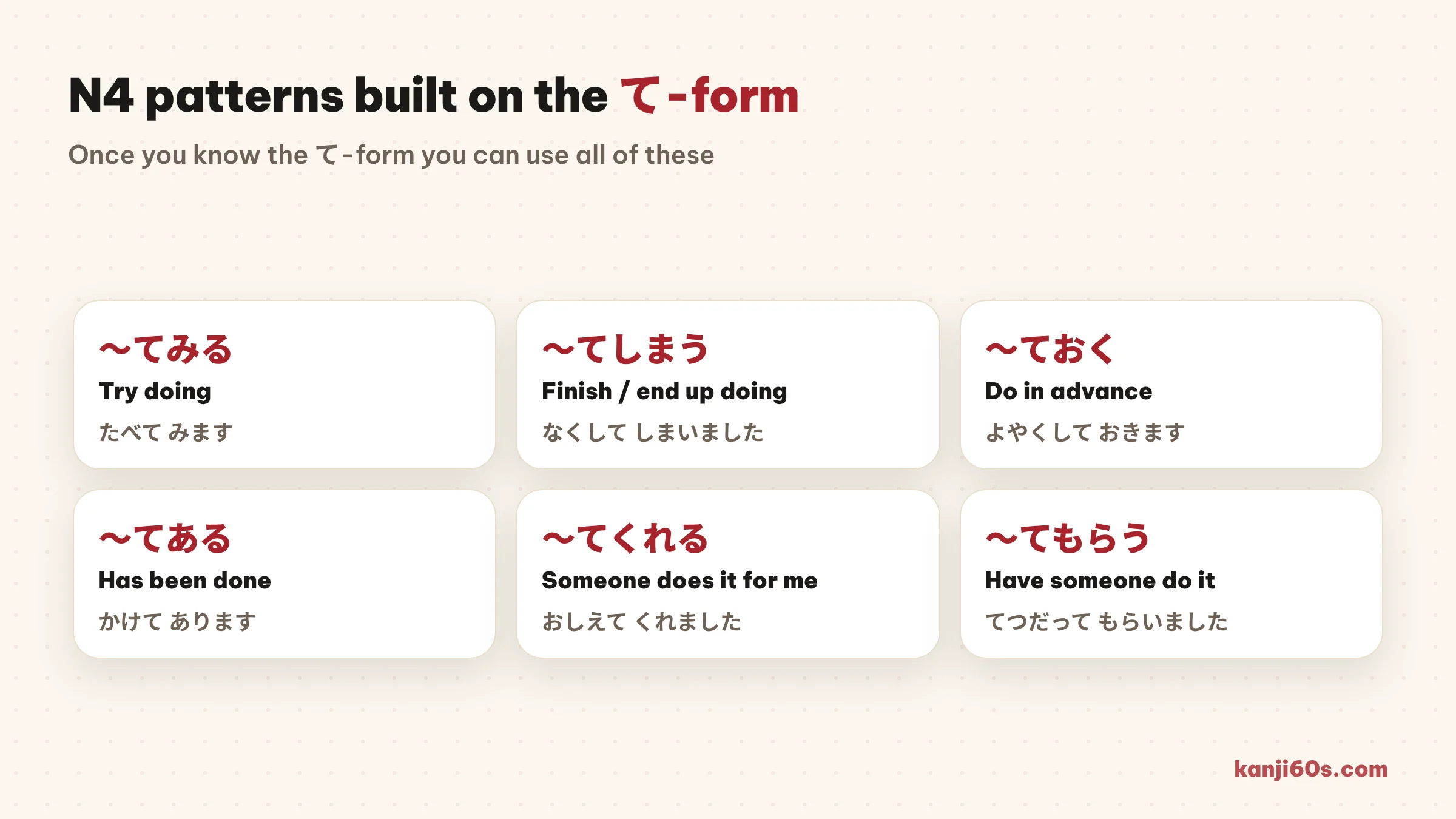
Yes. Vてください and Vています are core N5 grammar, and the other uses appear at N5 and N4.
Is the ta-form made the same way?
Yes. Replace て with た and で with だ: 書いて → 書いた, 読んで → 読んだ, 食べて → 食べた.
Why is 行く an exception?
By the く rule it would become 行いて, but the standard form is 行って. It is the only common exception in group 1.
 Grammarは vs が in Japanese: Clear Rules, Examples and Common Mistakes
 Study methodHow to Learn Kanji Fast and Remember Them: The Mind-Map Method
 Study planJLPT N5 Kanji List: All 103 Kanji and a 3-Week Study Plan